Significant Figures Calculator – Know Exactly Which Digits Count
Type any number and see its significant figures counted for you — every digit lit up or greyed out, with the rule that decided it written underneath. Then round to as many sig figs as you need, or run a whole calculation and let the addition and multiplication rules round the answer the way your lab report demands.
What do you want to do?
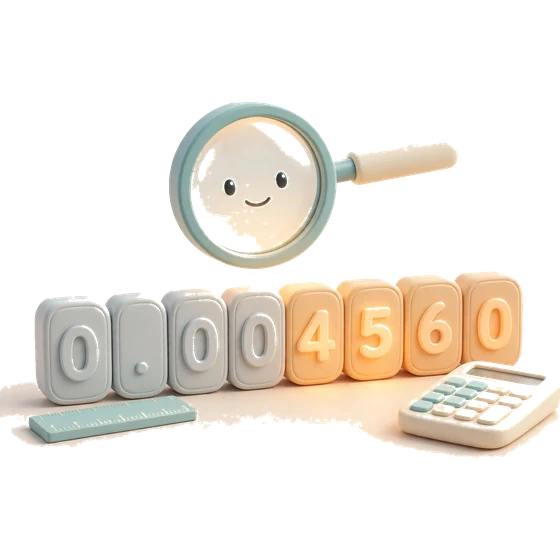
Scientific notation works too — try 1.20e3. The number loaded, 0.004560, is the classic trap: three zeros do nothing, the last zero does everything, and the honest count is 4.
Try one of these
🔒 Everything is calculated in your browser — your numbers never leave your device.
The count
Amber digits count. Grey digits only hold a place.
Anatomy of a number — every digit judged
Significant figures are a claim about measurement: the digits that were actually measured, no more and no fewer. Here is the number from the top of the page taken apart, digit by digit.
Keep exploring
Counted your figures — these work with what the count tells you.
Rounding Calculator
Round by decimal places, significant figures or nearest value, under all six rounding rules.
🔬Scientific Notation Calculator
Move numbers in and out of × 10 form — the honest way to show trailing zeros.
📊Average Calculator
Mean, median, mode and range — the results you will report to the right number of figures.
How it works in three steps
Find the first real digit
Counting starts at the first non-zero digit, wherever it hides. In 0.004560 that is the 4, four places deep — everything before it is scaffolding that only positions the decimal point.
Judge every digit after it
Non-zero digits always count, zeros between them always count, and zeros at the end count when a decimal point is written — because someone measured carefully enough to write them down.
Carry the count into the maths
A result may not claim more precision than its ingredients. Multiplication answers to the fewest figures going in; addition answers to the fewest decimal places. The count is the contract.
How the count is worked out
The trap, taken apart: 0.004560. Walk in from the left: 0, 0, 0 — place-holders, skipped. The 4 opens the count. The 5 and 6 follow. The final 0 closes it, because the decimal point is written and a measured zero is real information — the reading was 0.004560, not roughly 0.00456. Total: 4 significant figures.
The full house: 100.20 has five. The two zeros sit between non-zero digits, so they were measured; the last zero sits after the point, so it was measured too. Nothing in this number is decoration.
The honest repair: 1200 on its own is genuinely ambiguous — 2 figures by the standard reading, but the measurer may have known all four digits. Science refuses to guess: write 1.200 × 10^3 and the four figures are unmistakable, or 1.2 × 10^3 when only two are meant.
The carry: 999.9 to three figures. Keep 999, look at the dropped 9 — more than half — so the kept part climbs: 999 becomes 1000. That answer looks like one figure until you write it as 1.00 × 10^3, where the three figures stand up and are counted.
Going deeper
A trailing zero with no decimal point is the one genuinely unreadable mark in the whole system. If a scale reads 1200 grams, the 1 and the 2 are certain — but were the zeros measured, or are they just what a number that size looks like? The standard reading treats them as place-holders and counts 2 significant figures, which is the safe claim but not always the true one.
There are three honest escapes. Write a decimal point — 1200. declares all four digits measured. Draw a line over the last measured zero, a classroom convention some courses still teach. Or sidestep the whole question with scientific notation: 1.20 × 10^3 promises three figures, 1.200 × 10^3 promises four, and no reader has to guess which you meant.
Counting significant figures is about writing, not magnitude — it asks which digits a person deliberately put down. Computers quietly undo that. A stored binary fraction cannot hold 0.004560 exactly; the machine keeps something like 0.0045599999999999998, and any tool that counts from the stored value has already thrown your measured final zero away before the counting starts.
This calculator never converts your number into a binary fraction. It keeps the exact characters you typed, judges each one against the rules, and rounds on the digit string itself — the school method, done by hand, at machine speed. A trailing zero you wrote survives to be counted, and an exact half rounds like a true half.
Zeros that count, zeros that don’t: reading a number’s claim
The count panel of this page answers one question: how many digits in the number you typed actually carry measured meaning? The rules are few, but zeros make them tricky, because a zero can be a measured digit, a place-holder, or both at different positions. The table below runs the cases through this page’s own calculator, and the pattern in the last column is the whole rule set in miniature.
| Number | Significant figures | Which digits count | Why |
|---|---|---|---|
| 0.004560 (default) | 4 | 4, 5, 6, 0 | 3 leading zeros only hold the place — never significant; trailing zero counts because a decimal point is written, so it was measured on purpose |
| 1000 | 1 | 1 | No decimal point is written, so the trailing zeros are ambiguous; standard reading: they do not count. Written as 1.000 × 10³, every digit counts |
| 12345 | 5 | 1, 2, 3, 4, 5 | Every non-zero digit is significant |
The default number is the best teaching case on the page because it contains every kind of zero at once. In 0.004560, the three zeros before the 4 are leading zeros: they only position the decimal point, and the page states they are never significant — 0.004560 and 0.00004560 would carry the same measurement with more place-holding. The zero after the 6 is a trailing zero after a decimal point, and it counts: writing 0.004560 instead of 0.00456 claims the measurement was good to the sixth decimal place, and dropping that zero would weaken the claim. The scientific notation makes the same point without ambiguity: 4.560 × 10⁻³ shows exactly the four significant digits, and the first significant digit sits at 10⁻³, the thousandths place. The 1000 row shows why notation matters: “1000” without a decimal point claims only one significant figure under the standard reading, because its trailing zeros might be mere place-holders for a rounded thousand — but 1.000 × 10³ claims four, because every digit written in scientific notation is a claim. When a number’s trailing zeros are ambiguous, scientific notation is not decoration; it is the disambiguation.
Rounding to a chosen number of figures is the same honesty applied in reverse: keep the figures you can defend and turn the rest into place-holders. On this page, 12345 rounded to 3 significant figures becomes 12,300 — the digits after the third figure become place-holding zeros, “same size, honestly fewer claims”, in the page’s own phrase, with the scientific form 1.23 × 10⁴. Rounded to 2 figures it becomes 12,000 (1.2 × 10⁴). And the carry case shows why rounding must be done on the whole number, not digit by digit: 999.9 rounded to 3 significant figures becomes 1,000 — written as 1.00 × 10³ so that recounting it still gives exactly 3 significant figures, because a bare “1000” would read as 1 under the standard rule. A rounded answer that cannot survive a recount has not been rounded; it has been damaged. Count the answer again, as this page invites you to, and the figure count must come back exactly.
Two rules for operations, and why they differ
When numbers are combined, the result cannot be more precise than its weakest input — but “weakest” means different things for multiplication and for addition, and confusing the two rules is the commonest significant-figure error. This page’s operation panel applies both, and the probed cases below show each rule doing its own job.
| Operation | Raw result | Rule applied | Reported result |
|---|---|---|---|
| 2.34 × 1.2 (default) | 2.808 | Fewest significant figures (2) | 2.8 |
| 2.34 + 1.2 | 3.54 | Fewest decimal places (1) | 3.5 |
| 100.5 + 2.35 | 102.85 | Fewest decimal places (1) | 102.9 |
| 5.55 − 2.2 | 3.35 | Fewest decimal places (1) | 3.4 |
Multiplication and division use significant figures: 2.34 (3 figures) × 1.2 (2 figures) can claim only 2 figures, so 2.808 becomes 2.8, because the 1.2 input is only good to two figures and the extra digits of the product are borrowed precision. Addition and subtraction use decimal places instead: 2.34 + 1.2 can claim only 1 decimal place, because the 1.2 input is unknown beyond its first decimal, so 3.54 becomes 3.5 — and 100.5 + 2.35 becomes 102.9, not 102.85, even though 2.35 carries two decimal places, because the 100.5 input stops at one. The subtraction row shows the rounding direction on a tie: 5.55 − 2.2 = 3.35 exactly, and the engine reports 3.4, rounding the half up to the one decimal place allowed. The reason the rules differ is the reason the operations differ: multiplication scales uncertainty proportionally, so relative precision (figures) is what survives, while addition shifts uncertainty absolutely, so absolute precision (decimal places) is what survives. A result that mixes the rules — say, quoting 2.808 for the multiplication, or 102.85 for the addition — claims knowledge the inputs never contained, and the page’s “raw result” display exists precisely so you can see the unrounded value beside the honest one and judge the difference.
Scientific notation: the claim made explicit
Scientific notation is not a different way of writing a number; it is the same number with its claim made explicit, because every digit written in the coefficient counts. This page’s count panel proves it on entry: type 1.20e3 and the calculator counts 3 significant figures, shows 1.20 × 10³, and places the first significant digit at 10³ — the thousands place — because the trailing zero in 1.20 is written deliberately and therefore counts, exactly as the trailing zero in 0.004560 counts. Type the same value as 1200, without a decimal point, and the standard reading gives only 2 significant figures (the 1 and the 2), with the two zeros ambiguous place-holders — the same value, a weaker claim, purely because of how it was written. The notation you choose is therefore part of the measurement: a value recorded as 1.20e3 asserts three figures, a value recorded as 1200 asserts one, and a reader who treats them as interchangeable has already misread one of them.
The round panel shows the same explicitness from the other side. Rounding 999.9 to 3 figures gives 1,000 as a plain number — but the page reports it as 1.00 × 10³, because a bare 1000 would recount as 1 figure and the rounding would be undone by its own display. Rounding 12345 to 3 figures gives 12,300 (1.23 × 10⁴), where the trailing zeros are visibly place-holders after the third figure, and rounding it to 2 figures gives 12,000 (1.2 × 10⁴). In each case the scientific form is the check: count the digits in the coefficient and you must get the figure count you rounded to, no more and no less. A result whose plain form and scientific form disagree about its own precision is a result displayed wrongly, and this page’s habit of showing both forms side by side exists so that disagreement can never hide. When you report a rounded result elsewhere, report it in the form that survives a recount — usually the scientific form — and treat any form that does not survive as a draft, not a result.
Division, and the raw result beside the honest one
Division exposes the operation rule in its sharpest form, because division so often produces an unending decimal. On this page, 10 ÷ 3 gives a raw result of 3.33333333333333… and a reported result of 3 — one significant figure, because both inputs (10, read as 1 figure without a decimal point, and 3, one figure) allow only one. Reporting 3.333… would claim fourteen figures from inputs that contain one each; reporting 3 claims exactly what the inputs support. The page shows both values side by side — raw and reported — so the rounding is never hidden: you can see what the arithmetic produced and what the precision rules permit, and the gap between them is the measure of how much of the raw decimal was never real. That gap is largest for division, because division manufactures digits indefinitely, and every manufactured digit past the allowed count is invented precision.
The same side-by-side display disciplines the other operations. For 2.34 × 1.2 the raw result is 2.808 and the reported result 2.8: two digits of the raw value are discarded, not because they are wrong as arithmetic but because the 1.2 input cannot support them. For 100.5 + 2.35 the raw result is 102.85 and the reported result 102.9: the second decimal place is discarded because the 100.5 input stops at one decimal place, and the rounding carries the first decimal from 8 to 9. In both cases the honest result is shorter than the raw result, and the shortening is the point: significant figures are not a formatting preference but a statement about what was measured, and a result longer than its inputs is a result that claims measurements nobody made. Keep the raw value for checking your arithmetic, and quote the reported value when the number leaves the page — the raw value is for you, the reported value is for everyone else.
Zeros in the wild: money, rulers and the trailing-zero trap
The rules stop being abstract the moment you record a real measurement, because everyday recording habits hide significant figures in plain sight. The table below runs four ordinary recordings through this page’s count panel, and each row is a trap that catches someone.
| Recorded as | Significant figures | Scientific form | The trap |
|---|---|---|---|
| 1000.00 | 6 | 1.00000 × 10³ | Two decimal places written means measured to the cent: every digit counts, including both trailing zeros |
| 1200 | 2 | 1.2 × 10³ | Without a decimal point, the trailing zeros do not count; only the 1 and the 2 carry meaning |
| 12.0 | 3 | 1.20 × 10¹ | The trailing zero after the decimal point counts: 12.0 claims tenths, 12 claims only units |
| 0.050 | 2 | 5.0 × 10⁻² | The leading zero never counts; the trailing zero after the 5 does, because the decimal point is written |
Money is the commonest trap. A price written as 1000.00 claims six significant figures — measurement to the cent — while the same amount written as 1000 claims one, and a budget that adds 1000.00 to other cent-precise figures and then reports the total to six figures has borrowed precision from the notation, not from the measurement. A ruler reading is the same trap in miniature: 12 cm claims two figures (nearest centimetre), while 12.0 cm claims three (nearest millimetre), and the difference between them is not a tenth of a centimetre of length but a tenfold difference in claimed precision. The 0.050 row completes the set: the leading zero is never significant, the 5 is, and the trailing zero is significant precisely because it was written after a decimal point — 0.05 claims one figure, 0.050 claims two, and a solution prepared as 0.050 molar is a different claim from one prepared as 0.05 molar, even though the amounts are the same. In every case the rule is the same and the remedy is the same: write the digits you measured, no more and no fewer, and when the plain form leaves the count ambiguous — trailing zeros in a whole number — write the scientific form, where the count is the number of digits in the coefficient and cannot be misread. The calculator’s count panel exists to make that check mechanical: type the number as you recorded it, read the count, and if the count is not the precision you meant to claim, re-record the number rather than defending the notation.
Exact numbers: when counting does not limit precision
Not every number in a calculation carries measurement uncertainty. Counted quantities — 12 eggs, 3 trials, 25 students — are exact, with effectively infinite significant figures, and they never limit the precision of a result. Defined conversions are exact too: 1 inch is defined as exactly 2.54 centimetres, and 1 foot is exactly 12 inches, so converting between them introduces no rounding limit. Only measured quantities — readings from instruments, with real uncertainty — carry significant figures into a result.
The distinction matters in practice. Dividing a measured total of 87.5 grams by a counted 5 samples gives 17.5 grams per sample, limited by the three significant figures of the measurement, not by the count. But dividing by a measured 5.0 millilitres would limit the result to two significant figures. Before rounding any result, sort the inputs into measured and exact: only the measured ones vote on the answer’s precision.
Rounding half-way cases: why 2.5 rounds to 2 sometimes
When a digit to be dropped is exactly 5 followed by nothing, the common school rule — always round up — is not the only convention. Scientific and statistical practice often uses round-half-to-even, also called banker’s rounding: 2.5 rounds to 2, and 3.5 rounds to 4, because the result is always the even neighbour. The purpose is to avoid a systematic upward bias when many half-way cases are rounded, as they are in large datasets and in financial computation. This page uses the conventional half-up rule unless a setting says otherwise, which matches school and most laboratory practice; if your course or workplace specifies banker’s rounding, apply it to the unrounded result, not to an already-rounded one.
Whatever convention applies, never round intermediate steps. Carry at least two extra digits through a multi-step calculation and round only the final answer to the correct number of significant figures. Rounding early compounds: a value rounded to two figures at each of five steps can drift by several percent from the correctly rounded final answer, and the error is invisible because every intermediate result looked reasonable.
Frequently asked questions
What are significant figures?
Significant figures are the digits in a number that carry real, measured meaning — everything from the first non-zero digit to the last digit that was actually measured. They are how a number reports its own precision: 4.560 promises more knowledge than 4.56, because the trailing zero says the next place was measured too and happened to be zero. Zeros that only position the decimal point, like the three in 0.004560, claim nothing and are not significant.
Are trailing zeros significant?
It depends entirely on the decimal point. When a point is written, trailing zeros count: 3.400 has 4 significant figures and 100.20 has 5. When no point is written, trailing zeros are ambiguous and the standard reading leaves them out: 3400 counts 2. If those zeros really were measured, say so in scientific notation — 3.400 × 10^3 makes all four figures undeniable.
How many significant figures are in 0.004560?
Four: the 4, 5, 6 and the final 0. The three zeros before the 4 are leading zeros — they only hold the place and never count. The zero after the 6 is a trailing zero with a decimal point written, so it was measured and it counts. Written in scientific notation the same number is 4.560 × 10^-3, where the four figures are the four digits you can see in front of the × sign.
How do I round 12,345 to 3 significant figures?
Keep the first three significant digits — 1, 2 and 3 — and look at what falls off: 45, which is less than half of the last kept place, so the kept part stands. Everything after the 3 becomes place-holding zeros: 12,300. The size of the number has not changed, only its claim — three figures of knowledge, honestly labelled.
Why does 999.9 to 3 significant figures become 1,000?
Because of the carry. Keeping three figures means keeping 999, and the dropped 9 is more than half, so the kept part climbs by one — and 999 plus one rolls over into 1,000. The answer looks like a single figure, which is exactly why scientists check it in scientific notation: 1.00 × 10^3, where the 1 and its two zeros are precisely the three significant figures you asked for.
Do the rules change when I add or multiply?
Yes — two different rules for two families of operations. Adding and subtracting answer to decimal places: the result keeps as many decimal places as the input with the fewest, so 1.23 + 4.567 = 5.80, not 5.797. Multiplying and dividing answer to significant figures: the result keeps as many figures as the input with the fewest, so 2.34 × 1.2 = 2.8, not 2.808. A result may never claim more precision than the numbers that produced it.
Why does 0.004560 have 4 significant figures, not 7?
Because the three leading zeros only hold the place and are never significant, while the trailing zero counts. In 0.004560 the significant digits are 4, 5, 6 and 0: the leading zeros position the decimal point (0.004560 and 0.00004560 carry the same measurement with more place-holding), and the final zero counts because a decimal point is written, so it was measured on purpose — dropping it would weaken the claim to the sixth decimal place. Scientific notation shows it cleanly: 4.560 × 10⁻³.
Why is 1000 only 1 significant figure, but 1.000 × 10³ is 4?
Because trailing zeros without a decimal point are ambiguous: they might be measured digits or mere place-holders for a rounded thousand, and the standard reading counts only the 1. In scientific notation every digit written is a claim, so 1.000 × 10³ claims four figures. The same lesson appears in rounding: 999.9 rounded to 3 figures becomes 1,000, but the page writes it as 1.00 × 10³ so that recounting it still gives exactly 3 — a bare “1000” would read as 1 and the rounding would be damaged, not done.
Why does multiplication use figures but addition uses decimal places?
Because the operations propagate uncertainty differently. Multiplication scales it proportionally, so relative precision survives: 2.34 × 1.2 can claim only the fewest figures (2), giving 2.8 from 2.808. Addition shifts it absolutely, so absolute precision survives: 2.34 + 1.2 can claim only the fewest decimal places (1), giving 3.5 from 3.54, and 100.5 + 2.35 gives 102.9 from 102.85 even though 2.35 carries two decimal places, because 100.5 stops at one. Mixing the rules claims knowledge the inputs never contained.
How do I check a rounded answer is still honest?
Count it again. 12345 rounded to 3 figures is 12,300 (1.23 × 10⁴): recounting gives exactly 3 figures, because the zeros after the third figure are place-holders, not claims. 999.9 rounded to 3 figures is 1,000, but only as 1.00 × 10³ does the recount return 3 — as a bare 1000 it returns 1. If the recount does not return the figure count you rounded to, the representation, not the rounding, is at fault; scientific notation fixes it.
How many significant figures does 0.00450 have?
Three: 4, 5, and the trailing 0. Leading zeros are never significant — they only locate the decimal point. The trailing zero after the 5 is significant because it follows a non-zero digit and a decimal point, showing the measurement was read to that place.
How many significant figures does 1005 have?
Four. Zeros between non-zero digits (captive zeros) are always significant. The zeros in 1005 are between 1 and 5, so all four digits count.
Related calculators
Significant Figures Explained
Rules, rounding, and scientific notation.
🎯Rounding Calculator
Decimal places, sig figs and nearest values under six rules.
🔬Scientific Notation
Convert to and from × 10 form, exactly.
🧮Scientific Calculator
Powers, roots, logs and trig for heavier working.
📈Statistics Calculator
Mean, spread and standard deviation from a list.
💯Percentage Calculator
Percentages of numbers, and one number as a percentage of another.