Volume Calculator
Find the volume of a cube, rectangular box, cylinder, sphere, or cone in seconds.
Enter dimensions
Result
- Every shape runs a single formula, and the calculator shows it under the result: a cube is s³ (3³ = 27.00), a box is l × w × h (4 × 5 × 6 = 120.00), a sphere is (4/3)πr³ (r = 3 → 113.10).
- Cones and pyramids hold exactly one-third of their parent cylinder or box — the factor people forget most — and a sphere fills exactly two-thirds of the cylinder that wraps it.
- Convert units before cubing: 1 m = 100 cm, but 1 m³ = 1,000,000 cm³. Every dimension here carries its own unit dropdown, and each one is converted before the formula runs.
Shape diagram
27.00 cm³
Illustration
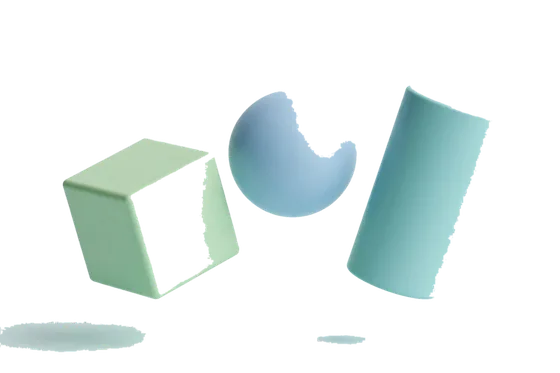
Five shapes, one calculator — cubes, boxes, cylinders, spheres, and cones.
Keep exploring
How it works
Pick your shape
Choose a cube, rectangular box, cylinder, sphere, or cone from the dropdown. Only the inputs you need appear.
Enter the dimensions
Type the side, length, width, height, or radius — every dimension has its own unit dropdown (centimeters, meters, inches, feet, millimeters, yards), so you can mix units freely. Results update live as you type.
Read the result
Get the volume to two decimals, the active formula with your numbers plugged in, plus a bonus surface-area stat.
Formulas this calculator uses
There is no single formula for volume — every shape has its own, and picking the right one is most of the job. These are the seven core formulas I built this calculator around, each with its symbols explained and a worked example I have checked by hand. The other four shapes I support — conical frustum, ellipsoid, spherical cap and tube — are in the full 11-shape table in the guide below.
Cylinder — the cylinder volume formula
r = radius of the circular base · h = height, the distance between the two circular faces
I picture a cylinder as a stack of identical circles: the base circle has area πr², and the height counts how many of those circles are stacked — so the cylinder volume formula is really just base area × height.
Worked example: r = 3, h = 5 → V = π × 3² × 5 = π × 45 = 141.37 cubic units. Measured the diameter instead? Halve it first — a can 6 units wide has r = 3.
Cone — volume of a cone
r = base radius · h = vertical height, apex straight down to the centre of the base (not the slanted side)
The volume of a cone is exactly one-third of the cylinder with the same base and height, so I work out the cylinder and take a third. If a problem gives me the slant height instead of h, I recover h with Pythagoras first.
Worked example: r = 4, h = 9 → V = (1/3) × π × 16 × 9 = 48π = 150.80 cubic units.
Cube — volume of a cube
s = one edge length — all twelve edges of a cube are equal
The simplest formula I use: length × width × height collapses into s × s × s. Working backwards is just as easy — give me a cube’s volume and I take the cube root to get the edge.
Worked example: s = 6 → V = 6³ = 216 cubic units.
Rectangular box — volume of a box
l, w, h = length, width and height, in any order — the product is the same
This is the formula I reach for more than any other: rooms, crates, aquariums, moving boxes. When people ask for the “volume of a rectangle”, this is what they mean — a flat rectangle has area, but the 3D box built on it has volume.
Worked example: 4 × 5 × 6 → V = 20 × 6 = 120.00 cubic units.
Sphere
r = radius, centre to surface — if I am given the diameter instead, r = d ÷ 2
Pick Sphere in the tool above and it works as a dedicated sphere volume calculator — I use it for balls, globes and round tanks. For a hemisphere (a dome or a bowl), I halve the sphere result: V = (2/3)πr³.
Worked example: r = 5 → V = (4/3) × π × 125 = 523.60 cubic units — and the matching hemisphere is 523.60 ÷ 2 = 261.80.
Square pyramid
B = base area · h = vertical height, base to apex — for a square base, B = a² where a is the base edge
Like the cone, a pyramid holds exactly one-third of its parent box. I write the formula as (1/3)Bh because it works for any base shape: find the base area, multiply by the height, take a third. The pyramid volume calculator mode in the tool above uses a square base, so B = a².
Worked example: a = 6, h = 9 → V = (1/3) × 36 × 9 = 108.00 cubic units.
Capsule
r = radius · h = height of the straight cylinder section only — the two rounded ends together make one complete sphere
A capsule is a cylinder wearing two hemispherical caps, so I add the cylinder body to a full sphere of the same radius. One warning from my own mistakes: if h includes the caps, I double-count them.
Worked example: r = 2, h = 6 → V = π × 4 × 6 + (4/3)π × 8 = 75.40 + 33.51 = 108.91 cubic units.
Going deeper
Why does the sphere formula use 4/3?
The (4/3)πr³ formula comes from integral calculus: slicing a sphere into thin disks and summing their volumes gives a clean factor of 4/3. Intuitively, a sphere fills exactly two-thirds of the cylinder that wraps it (same radius, height 2r), and since that cylinder holds 2πr³, the sphere holds (4/3)πr³ ≈ 113.10 when r = 3.
How do cubic units and conversions work?
Volume is always in cubic units — the unit you measure with, raised to the third power. Measure in centimeters and you get cm³; in feet, ft³. Converting is easy to get wrong: 1 m = 100 cm, but 1 m³ = 1,000,000 cm³, because the factor cubes too. Always convert the linear dimensions before cubing, or cube the conversion factor.
Common volume mistakes to avoid
Three errors cause most wrong answers: mixing units (radius in inches, height in centimeters), using diameter where the formula needs radius (halve it first — the sphere at r = 3 gives 113.10, but at d = 6 mistaken for r it would balloon eightfold), and forgetting that volume scales with the cube — doubling every dimension multiplies volume by 8, not 2.
The complete guide to volume
Every formula this calculator uses, how to pick the right shape, unit conversions, and real-world volume problems solved step by step.
🧮Volume formulas — all 11 shapes
Learning how to calculate volume starts with one idea: a volume calculator multiplies three dimensions. Here are all the formulas, with the calculator’s acceptance values so you can verify:
| Shape | Formula | Example |
|---|---|---|
| Cube | V = s³ | 3³ = 27.00 |
| Rectangular box | V = l × w × h | 4 × 5 × 6 = 120.00 |
| Cylinder | V = πr²h | r=2, h=5 → 62.83 |
| Sphere | V = (4/3)πr³ | r=3 → 113.10 |
| Cone | V = (1/3)πr²h | r=3, h=6 → 56.55 |
| Square pyramid | V = (1/3)a²h | a=5, h=12 → 100.00 |
| Capsule | V = πr²h + (4/3)πr³ | r=1.5, h=3 → 35.34 |
| Conical frustum | V = (1/3)πh(r² + rR + R²) | r=0.2, R=1.5, h=4 → 10.85 |
| Ellipsoid | V = (4/3)πabc | 1.5, 2, 5 → 62.83 |
| Spherical cap | V = (1/3)πh²(3R − h) | R=1.68, h=0.3 → 0.45 |
| Tube | V = πh(R² − r²) | R=3, r=2, h=4 → 62.83 |
Why these work: a pyramid and cone are each exactly 1/3 of their “parent” prism/cylinder — a beautiful result you can verify by filling: three pyramids of base a² and height h fill a cube of a²h. A capsule is a cylinder plus a sphere; a frustum is a large cone minus a small one; a tube is an outer cylinder minus an inner one.
🧭How to find volume: the method I use every time
When someone asks me how to find volume, I give them the same four steps, whatever the object is. Step 1 — identify the shape. Almost everything I meet is one of the eleven shapes above, or two of them joined together, like a silo (cylinder + hemisphere). Step 2 — measure in one unit. I convert everything to centimetres, inches or feet before I start; a radius in inches with a height in centimetres is the mistake I see most. Step 3 — apply the formula. Each shape’s formula from the cards above, with the radius — never the diameter — wherever an r appears. Step 4 — cube the unit and sanity-check. Feet in means ft³ out, and I compare the answer against a shape I know: a cone answer bigger than its cylinder means I dropped the ⅓.
Worked example — when all you have is the diameter. I measure a cylindrical water tank: 10 ft across, 12 ft tall. The formula needs the radius, so I halve first: r = 10 ÷ 2 = 5 ft. Then V = πr²h = π × 25 × 12 = 942.48 ft³. Because I measured in feet, the answer is honestly in cubic feet — and at 7.48052 gallons per ft³, that tank holds about 7,050 gallons. If I had plugged the diameter straight in as r, I would have claimed four times the real volume.
📏Units — from mm³ to gallons
Volume units are cubed length units: mm³, cm³, m³, in³, ft³, yd³. The calculator accepts all six — and converts every result to liters and US gallons:
| 1 unit³ | Liters | US gallons |
|---|---|---|
| 1 mm³ | 0.000001 | — |
| 1 cm³ | 0.001 | 0.000264 |
| 1 m³ | 1,000 | 264.17 |
| 1 in³ | 0.016387 | 0.004329 |
| 1 ft³ | 28.32 | 7.48 |
| 1 yd³ | 764.55 | 201.97 |
Key conversions to memorize: 1 liter = 1,000 cm³ (a 10 cm cube). 1 m³ = 1,000 liters. 1 ft³ = 28.32 L = 7.48 gal. 1 US gallon = 3.785 L = 231 in³ exactly.
Unit trap: converting length units is linear, but volume units cube the factor. 1 m = 100 cm, but 1 m³ = 1,000,000 cm³. Mixing units mid-calculation (radius in cm, height in m) is the #1 volume error when you work by hand — in this calculator every dimension has its own unit dropdown, and each one is converted before the formula runs.
🧪How to measure volume — units and the displacement trick
I get asked how to measure volume — and what volume is measured in — more than almost anything else. The honest answer: volume is measured in cubic units, the cube of whatever length unit I measured with: cm³, m³, in³, ft³. The cubing is literal — one cubic foot is a 12 in × 12 in × 12 in box, so 1 ft³ = 12 × 12 × 12 = 1,728 in³. For liquids I switch to the capacity units built on top of them: litres and US gallons (1 ft³ = 28.32 L = 7.48 gal, from the table above).
When no formula fits, I measure by displacement. It is the method I trust for irregular objects — a rock, a wrench, a piece of coral. I fill a graduated container and note the level (say 250 mL), lower the object in until it is fully submerged, and read the new level (310 mL). The object’s volume is the difference: 310 − 250 = 60 mL = 60 cm³. Two cautions I have learned the hard way: the object must sink and be fully covered (hold floaters under with a thin pin), and anything that absorbs water or dissolves will lie to you — for those, I wrap it thin or fall back on approximating it with the shapes above.
🎯Picking the right shape
- Box / crate / room → Rectangular box. A 4×5×6 m room is 120 m³.
- Can / pipe / tank → Cylinder. A water heater (r=0.3 m, h=1.2 m) holds π × 0.09 × 1.2 ≈ 0.339 m³ ≈ 339 liters.
- Ball / globe → Sphere.
- Funnel / ice-cream cone → Cone.
- Pyramid roof / paperweight → Square pyramid.
- Pill / propane tank → Capsule (cylinder + two hemispheres).
- Bucket / lampshade / planter → Conical frustum (a cone with the tip cut off).
- Rugby ball / watermelon → Ellipsoid.
- Dome / contact lens → Spherical cap.
- Pipe wall / donut ring → Tube (hollow cylinder).
Approximation strategy: real objects are rarely perfect shapes. A swimming pool with sloped sides ≈ frustum; a grain silo ≈ cylinder + hemisphere (capsule); a shipping container ≈ box. Pick the closest shape — for estimates within 5–10%, that’s plenty.
Water displacement for the truly irregular: fill a graduated container, note the level, submerge the object, read the new level. A rock raising 500 mL to 650 mL has volume 150 cm³. For large objects, weigh the displaced water: 1 kg of water = 1 L = 1,000 cm³.
🏠Real-world volume problems
Concrete for a slab: 10 ft × 12 ft × 0.5 ft = 60 ft³. Concrete is ordered in cubic yards: 60 ÷ 27 = 2.22 yd³ — order 2.5 (waste factor ~10%). In liters: 60 × 28.32 = 1,699 L.
Fish tank: 60 cm × 30 cm × 40 cm = 72,000 cm³ = 72 liters (÷ 1,000). Fill to 90%: 64.8 L.
Moving boxes: a 2×2×2 ft box = 8 ft³. A studio apartment (~800 ft³ of stuff) needs roughly 100 box-equivalents — before furniture.
Propane tank (capsule): r=1.5 ft, cylinder section h=3 ft → 35.34 ft³ × 7.48 = 264 gallons of capacity.
Planter (frustum): top r=0.2 m, bottom R=0.15 m… wait — top is usually wider. Top R=0.25 m, bottom r=0.15 m, h=0.4 m: V = (1/3)π(0.4)(0.0225 + 0.0375 + 0.0625) = (1/3)π(0.4)(0.1225) ≈ 0.0513 m³ ≈ 51 liters of soil.
🌊Volume vs capacity vs displacement
Three related but distinct ideas:
- Volume is the 3D space an object occupies — the formulas in this guide. A solid steel ball’s volume is (4/3)πr³.
- Capacity is how much a container holds — the interior volume. A fish tank’s capacity uses inside dimensions; its (glass) volume uses outside.
- Displacement is the volume of fluid pushed aside by a floating object — equal to the object’s submerged volume. A ship displaces water equal to its weight (Archimedes’ principle).
Archimedes’ eureka: the original volume hack. Drop an irregular object in water; the rise in water level × container base area = the object’s volume. No formula needed. Jewelers still use this for gemstones; engineers for complex castings.
For containers, always use capacity thinking: the tube shape’s inner radius exists precisely to compute what a pipe holds (πr²h with the inner r) versus what it is (πh(R²−r²)).
🏛️A short history of measuring volume
Volume is among the oldest measurements — grain, oil and wine were taxed by volume millennia before length was standardized. The Egyptian hekat (~4.8 L) measured grain; the Roman amphora (~26 L) was the standard wine jar; the bushel and firkin survived into modern trade.
The metric revolution tied volume to length elegantly: 1 liter = 1 cubic decimeter exactly, and 1 liter of water = 1 kg. No other unit system achieves this — a US gallon is 231 in³ by 1707 decree (Queen Anne’s wine gallon), with no relation to the pound.
The liter was originally defined (1795) as 1 dm³, redefined (1901) as the volume of 1 kg of water, then redefined back (1964) to 1 dm³ exactly — the 1901 definition was 1.000028 dm³, and metrologists decided the tiny difference wasn’t worth the confusion.
🔬Volume in science and engineering
Chemistry: molarity is moles per liter — every titration depends on volume. A 1 M solution has 1 mole per liter; diluting 100 mL of 1 M to 1 L gives 0.1 M (M₁V₁ = M₂V₂).
Medicine: drug doses scale with body volume (via weight/BSA). An IV drip at 125 mL/hour for 8 hours delivers exactly 1,000 mL = 1 L.
Engineering: engine displacement is cylinder volume × cylinders — a 2.0 L engine displaces 2,000 cm³ per cycle. HVAC sizing uses room volume (m³), not floor area: a 4×5×6 m room (120 m³) needs ~12,000 BTU.
Earth science: an Olympic pool (50×25×2 m) holds 2,500 m³ = 2.5 million liters. Lake volumes are measured in km³ — Superior holds ~12,000 km³, or 12 quadrillion liters.
📦Packing, shipping and dimensional weight
Couriers charge by dimensional weight — whichever is greater: actual weight or volume ÷ a divisor. The standard divisor is 5,000 (cm³/kg) internationally or 139 (in³/lb) domestically in the US.
Example: a 50×40×30 cm box = 60,000 cm³ ÷ 5,000 = 12 kg dimensional weight. If the contents weigh 8 kg, you pay for 12 kg. A 20×20×20 in box = 8,000 in³ ÷ 139 = 57.6 lb dimensional.
Packing efficiency: spheres pack at ~74% (face-centered cubic) — a box of oranges is 26% air. Random packing (luggage, moving boxes) manages ~60–65%. When estimating truck loads, multiply the neat box volume by 1.5 to allow for voids.
Concrete reminder: always add 10% waste — and for slabs, order in full cubic yards (round up). A 2.22 yd³ job needs 2.5 yd³ ordered; the leftover fills the footing trench.
🧠Volume estimation tricks
When you can’t measure precisely:
- The fist: an average adult fist ≈ 0.5 L. A “handful” of rice ≈ 1/4 cup ≈ 60 mL.
- The bathtub: ~300 L (80 gal) full; a 10-minute shower at 9 L/min uses 90 L — a bath uses 3× more.
- The room: multiply floor area by ceiling height. 200 ft² × 8 ft = 1,600 ft³ ≈ 45 m³ ≈ 12,000 gallons of air.
- The pool: length × width × average depth. A 16×32 ft pool averaging 5 ft deep = 2,560 ft³ × 7.48 = 19,149 gallons.
- Fermi volumes: how many golf balls fit in a school bus? Bus ≈ 2.5×2.5×12 m = 75 m³; golf ball ≈ 40 cm³ = 4×10⁻⁵ m³; packing 70% → ~1.3 million. The method matters more than the answer.
🎨Volume in cooking, gardening and DIY
Cooking: 1 cup = 236.6 mL; 1 tablespoon = 14.8 mL; 1 teaspoon = 4.9 mL. Doubling a recipe? Multiply every volume — a 9×13 in pan (1,755 in³ ≈ 28.8 L of batter capacity) doubled needs a second pan, not a deeper fill.
Gardening: raised bed 8 ft × 4 ft × 1 ft = 32 ft³ = 1.19 yd³ of soil — order 1.5 yd³ (settling). A bag of soil is typically 2 ft³; you’d need 16 bags. Bulk delivery wins above ~1 yd³.
Paint: 1 gallon covers ~400 ft². A 12×15 ft room with 8 ft ceilings: walls = 2(12×8) + 2(15×8) = 432 ft² → ~1.1 gallons per coat. Volume of paint ≠ room volume — it’s surface area that matters.
Mulch: sold by the cubic yard. A 10×10 ft bed at 3 in deep: 100 ft² × 0.25 ft = 25 ft³ = 0.93 yd³ — order 1 yd³.
Aquariums: the classic 10-gallon tank is 20×10×12 in = 2,400 in³ ÷ 231 = 10.39 gal (sold as 10). Stock 1 inch of fish per gallon — the volume rule behind the rule.
📐Surface area — the companion number
The calculator shows a surface area stat under every volume — the two are linked by the square-cube law: double an object’s size and its surface area quadruples (2²) while volume octuples (2³).
This is why elephants have big ears (dumping heat from a relatively small surface) and why crushed ice cools drinks faster (more surface per volume). It’s also why insulation math uses surface area while heating math uses volume: a 4×5×6 m room has 120 m³ of air but 148 m² of walls/ceiling/floor losing heat.
Optimal shapes: of all solids, the sphere encloses the most volume per surface area — which is why bubbles, planets and water droplets are round. A cube of 27 cm³ has 54 cm² of surface; a sphere of the same volume has only ~43.5 cm².
🌐Metric vs imperial — living in both
Science, medicine and most of the world use metric; US construction and cooking use imperial. The calculator speaks both — the conversions that matter:
- Kitchen: 1 US gallon = 3.785 L; 1 quart = 0.946 L; 1 pint = 0.473 L; 1 cup = 236.6 mL; 1 fl oz = 29.57 mL.
- Construction: 1 yd³ = 27 ft³ = 764.55 L. Concrete, mulch and soil are sold by the yard.
- Fuel: US gallon (3.785 L) vs imperial gallon (4.546 L) — 20% apart. A “40 mpg” car in Britain is ~33 mpg in America.
- Swimming pools: US pools in gallons, Olympic specs in meters. A 20,000-gallon pool ≈ 75.7 m³.
Why the US gallon is 231 in³: it’s Queen Anne’s 1707 wine gallon, defined by a cylinder 7 inches across and 6 deep (π×3.5²×6 ≈ 231). The imperial gallon (1824) was redefined as 10 lb of water = 277.42 in³. Two gallons, two histories, one headache.
🧪Volume and density — from space to mass
Volume becomes mass through density: mass = volume × density. Water’s density (1 kg/L) makes it the reference:
- Water: 1 L = 1 kg. A 72 L fish tank holds 72 kg of water — plus glass, stand accordingly.
- Concrete: ~2,400 kg/m³. That 60 ft³ (1.7 m³) slab weighs ~4,080 kg — 4 tonnes. Respect the mixer truck.
- Soil: ~1,600 kg/m³ loose. A cubic yard (~0.76 m³) weighs ~1,200 kg.
- Air: 1.225 kg/m³. The 120 m³ room holds 147 kg of air — you’re breathing real mass.
- Gold: 19,300 kg/m³. A 1 L gold bar weighs 19.3 kg — the classic “heavy for its size” demo.
Buoyancy check: an object floats if its average density < fluid density. A 35.34 ft³ capsule displacing water supports 35.34 × 62.4 lb/ft³ ≈ 2,205 lb — the principle behind every boat hull.
⚠️Common volume mistakes
- Mixing units. Radius in inches, height in feet → garbage. Convert first.
- Diameter vs radius. Pipes are sold by diameter; the formulas need radius (÷ 2). A 4-inch pipe has r=2 in.
- Forgetting the 1/3. Pyramids and cones hold a third of their box/cylinder — the most-forgotten factor in volume math.
- Tube: inner ≥ outer. Physically impossible — the calculator rejects it.
- Cap height > diameter. A spherical cap can’t be taller than the sphere — also rejected.
- Confusing weight and volume. A liter of feathers vs a liter of lead: same volume, wildly different mass. Volume × density = mass.
💡 Rule of thumb: for containers, compute the inside dimensions (subtract wall thickness) — a tube’s inner radius exists for exactly this reason.
Density, mass and volume: finding one from the other two
Volume is space. Density is how much stuff is in the space. Mass is the product, and the triangle runs both ways.
Mass, volume, and density are tied by one relationship: mass equals volume times density, and density equals mass divided by volume. Rearranged, volume equals mass divided by density. That is the whole triangle, and every problem in this section is one of its three rearrangements. The only trap is units: the three quantities must be in matching units before the arithmetic runs. Density in kilograms per cubic metre needs volume in cubic metres and gives mass in kilograms; density in pounds per cubic foot needs volume in cubic feet and gives mass in pounds. Convert first, calculate second, and the triangle never lies.
The reference densities on this page are the ones the guide above already uses: water at 1 kilogram per litre, concrete at about 2,400 kilograms per cubic metre, gold at 19,300 kilograms per cubic metre, and water again at 62.4 pounds per cubic foot. Water is the reference because its density makes the arithmetic transparent — a litre of water is a kilogram, and a cubic foot of water is 62.4 pounds — and the other materials are read against it. Concrete at 2,400 is 2.4 times as dense as water; gold at 19,300 is 19.3 times as dense, which is why a litre of gold weighs 19.3 kilograms while a litre of water weighs one.
| Find | Formula | Needs |
|---|---|---|
| Mass | mass = volume × density | Volume and density, matching units |
| Volume | volume = mass ÷ density | Mass and density, matching units |
| Density | density = mass ÷ volume | Mass and volume, matching units |
Worked examples. Mass from volume: the guide’s fish tank holds 72 litres of water, and at 1 kilogram per litre that water weighs 72 kilograms, before glass and stand. Volume from mass: a gold bar weighing 19.3 kilograms, at 19,300 kilograms per cubic metre, occupies 19.3 ÷ 19,300 = 0.001 cubic metres, which is 1 litre. Density from mass and volume: a block measured at 5 kilograms with a volume of 0.002 cubic metres has a density of 5 ÷ 0.002 = 2,500 kilograms per cubic metre — denser than water, a little denser than concrete, and identified by the measurement, not by guessing the material first. One caution for liquids: density changes with temperature, so a density quoted at one temperature is approximate at another, and precise liquid work states the temperature the density was measured at. The companion guide works the triangle through more materials and more unit systems, with the conversion factors that keep the units honest.
Volume calculator FAQs
Quick answers about volume formulas.
How do I calculate the volume of a cube?
Cube the side length: V = s³. A cube with side 3 has volume 3 x 3 x 3 = 27.00 cubic units.
What is the formula for the volume of a cylinder?
V = πr²h. Square the radius, multiply by pi, then multiply by the height. For r = 2 and h = 5: π x 4 x 5 = 62.83 cubic units.
How do you find the volume of a sphere?
Use V = (4/3)πr³: cube the radius, multiply by pi, then multiply by 4/3. A sphere with radius 3 has volume 113.10 cubic units.
What units should I use for volume?
Any length unit works — centimeters, meters, inches, feet, millimeters, or yards — and every dimension has its own unit dropdown, so you can mix units (a radius in inches with a height in centimeters) and still get the right answer. The result appears in the unit you pick at the top, cubed, plus liters, milliliters, US gallons, cubic feet, and cubic meters.
How is the volume of a cone related to a cylinder?
A cone holds exactly one-third of a cylinder with the same radius and height: V = (1/3)πr²h. For r = 3 and h = 6 the cone is 56.55 cubic units.
Why does the calculator show an error?
The calculator needs positive numbers for every dimension — a side, radius, or height of zero or less has no physical volume.
What is the volume formula for a pyramid?
V = (1/3)a²h for a square pyramid — one-third of the base area times height. A pyramid with base edge 5 and height 12 has volume (1/3) × 25 × 12 = 100.00 cubic units. Select ‘Square pyramid’ in the calculator.
How do I calculate the volume of a capsule or pill shape?
A capsule is a cylinder plus a sphere: V = πr²h + (4/3)πr³, where h is the cylinder section’s height. For r=1.5 and h=3: π × 2.25 × 3 + (4/3)π × 3.375 = 35.34 cubic units.
How do I convert cubic feet to liters or gallons?
Multiply cubic feet by 28.3168 for liters, or by 7.48052 for US gallons. So 1 ft³ = 28.32 L = 7.48 gal. The calculator shows both conversions automatically under every result.
What is a conical frustum and how do I find its volume?
A frustum is a cone with the tip cut off (like a bucket). V = (1/3)πh(r² + rR + R²) where r and R are the two radii. For r=0.2, R=1.5, h=4: (1/3)π × 4 × (0.04 + 0.3 + 2.25) = 10.85 cubic units.
How do I work out the volume of this figure?
I use a three-step decision tree. First, name the shape: is it a box, a cylinder, a sphere, a cone, or a mix? Second, measure the dimensions its formula needs — the radius (not the diameter) for round shapes — and set the unit beside each dimension as you enter it; they do not all have to match. Third, apply that shape’s formula from the cards above, or pick the shape in the calculator and let it do the arithmetic. For a figure built from two shapes — a silo, say — I work out each part separately and add the volumes.
What’s the difference between volume and area?
Area measures a flat surface in square units (cm², ft²); volume measures three-dimensional space in cubic units (cm³, ft³). A flat shape has no thickness, so it has area but no volume — which is why ‘the volume of a circle’ or ‘the volume of a square’ is really two different questions: the flat shape’s area (πr² for a circle, s² for a square), or the solid built on it (a sphere at (4/3)πr³, a cube at s³). If your shape has depth, you want volume; if it is flat, you want area.
How do I find density if I know mass and volume?
Divide mass by volume, in matching units. A block of 5 kilograms with a volume of 0.002 cubic metres has a density of 5 divided by 0.002, which is 2,500 kilograms per cubic metre. State the units with the answer: a density without units is a number without meaning, because the same material reads 2,500 in kilograms per cubic metre and 2.5 in grams per cubic centimetre.
How do I find volume if I know mass and density?
Divide mass by density, in matching units. A gold bar weighing 19.3 kilograms, at a density of 19,300 kilograms per cubic metre, occupies 19.3 divided by 19,300, which is 0.001 cubic metres, or 1 litre. If the mass is in pounds and the density in pounds per cubic foot, the answer comes out in cubic feet: convert the units first, and the division does the rest.
Why does the same volume weigh different amounts for different materials?
Because density differs. Volume measures space, and density measures how much mass sits in each unit of that space, so the same litre holds 1 kilogram of water, about 2.4 kilograms of concrete, and 19.3 kilograms of gold. A litre of feathers and a litre of lead have the same volume and wildly different masses for exactly this reason: volume times density is mass, and density is the part that changes.
Related calculators
Related guides
In-depth guides to tanks, cylinders and liquid measure.
Tank shapes, dipstick charts and brim-full vs rated capacity.
What’s flat, what’s 3D — and which one your problem needs.
Everyday liquid units, converted exactly both ways.
Drums, tanks and wells with the diameter-first formula.
Finding one from the other two, with worked examples.